Research

Published

AI for Systems: Using LLMs to Optimize Database Query Execution

Summary

LLMs can fix a fundamental weakness in database query optimizers—their inability to reason about semantic correlations in data. By serializing physical execution plans into compact representations and applying targeted patches via evolutionary search, the system achieves median speedups of 1.1–1.2x and up to 4.78x on complex multi-join queries, without modifying the underlying engine.

Recent advances in AI have been driven by improvements in the underlying systems infrastructure. But this relationship does not have to be asymmetric: AI and LLMs can also be used to optimize the functional components of large-scale systems themselves. Our recent paper shows how AI can be used for database query optimization.

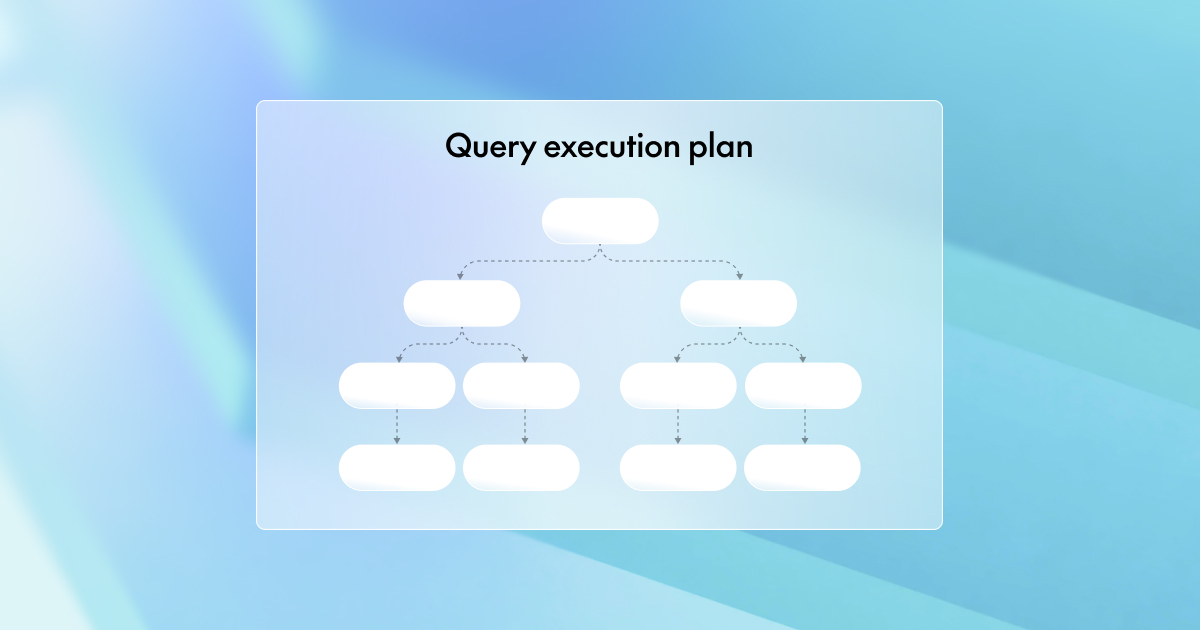
Traditional query optimization relies on cost-based estimators that calculate execution paths using statistical models and predefined heuristics. When executing a query like "find all sci-fi shows with space travel," the optimizer must decide on an execution strategy: Should it first filter for sci-fi shows and then check which have space travel, or vice versa? If the data is spread across multiple tables (e.g., a shows table and a genres table), which table should be scanned first and how should they be joined? The optimizer answers these questions by estimating how many rows will match each condition, then choosing the actual plan (the order of the operations) with the lowest estimated cost.

However, these estimates often assume attribute independence. Consider a streaming service dataset where you want to find shows that are both "sci-fi" AND "have space travel." If 15% of shows are sci-fi and 8% feature space travel, assuming independence would estimate that 1.2% of shows match both criteria (15% × 8%). However, space travel shows are overwhelmingly sci-fi, so the actual overlap is closer to 7%—nearly 6 times higher than predicted.

In fact, these systems generally function well but struggle when heuristics fail to account for semantic correlations within the schema or data. As noted in an example by Lohman (2014), cardinality estimation is the dominant source of optimizer inefficiency because row-count misestimates propagate through the cost model and can lead to systematically poor choices of join order, access paths, and physical operators. This order-of-magnitude error leads to suboptimal physical plans that require substantial engineering effort to correct manually.
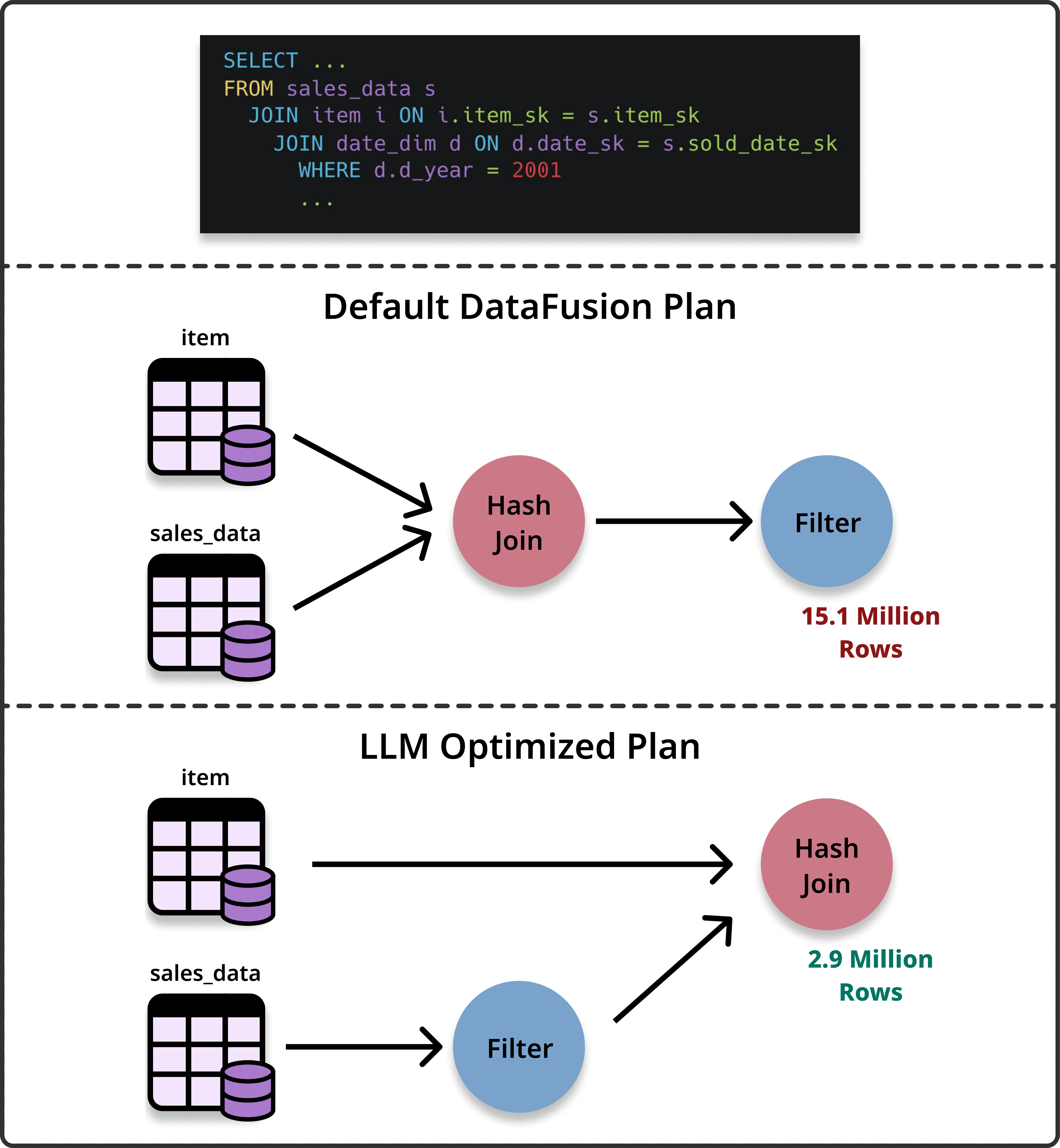
Semantic-aware join optimization. By pushing the selective `date` filter earlier, the LLM reorders the plan so the sales fact table is pruned from 15.1M to 2.9M rows before the join, yielding a much faster query.

Is query optimization a solved problem?

The persistence of these estimation errors shows that physical planning is not a solved problem, particularly for complex OLAP workloads where functional dependencies are common.

To address this, we introduce DBPLANBENCH, a harness that exposes the query execution process of the Apache DataFusion engine. This system exposes the internal physical operator graph, including join strategies and partitioning schemes, to an LLM. The primary technical challenge here is the information density inherent in raw physical plans, which contain verbose file paths, partition metadata, and type encodings that result in an "information explosion" and overwhelm context windows.

Without careful serialization, the entire plan can exceed 2M characters, making it impossible for LLMs to treat the inputs effectively and efficiently. Our harness implements a serialization layer that traverses the engine's physical operator graph and maps heterogeneous objects into a unified, token-efficient JSON schema.
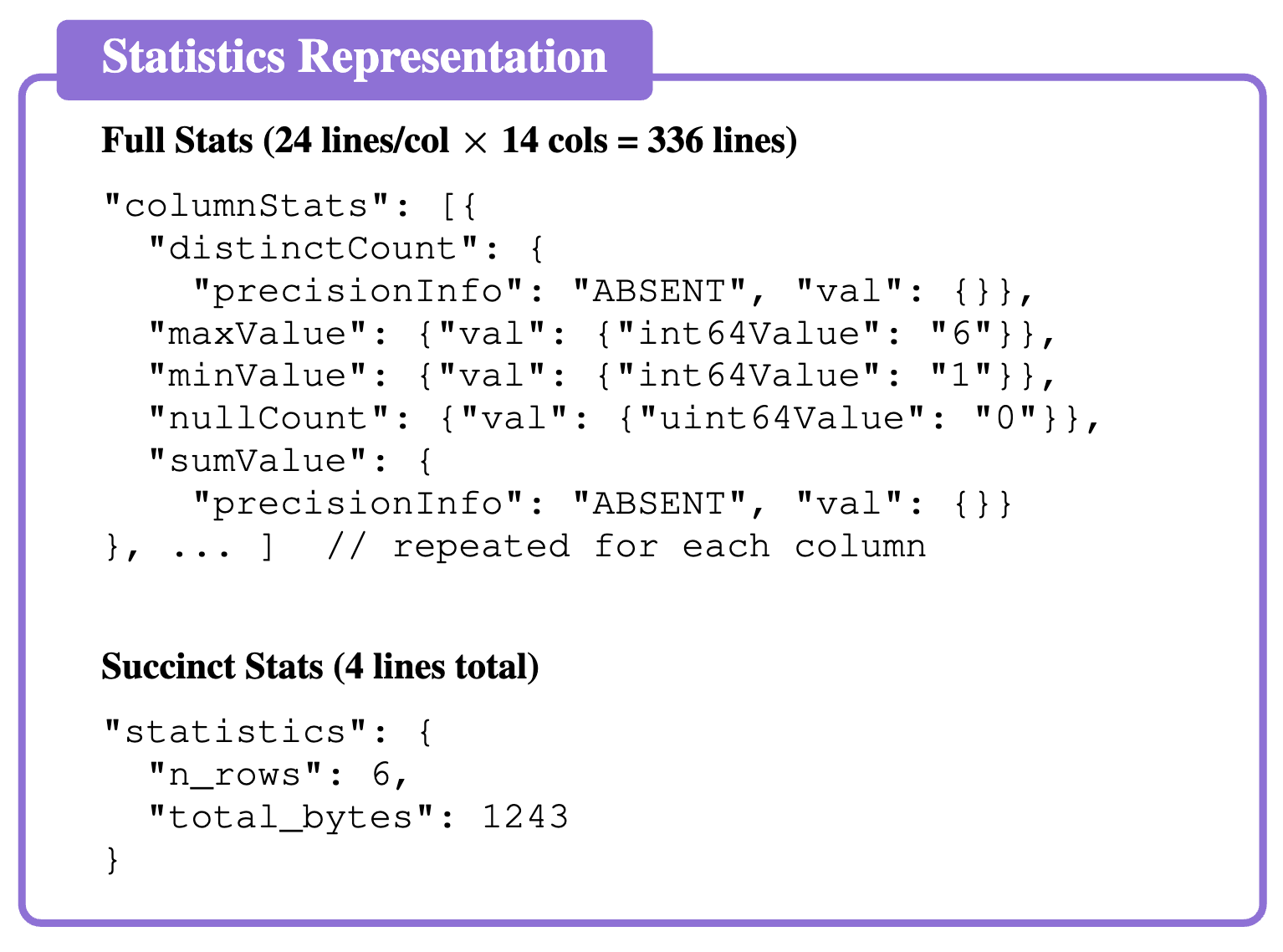
An illustrative snippet of compressing engine statistics for a single table. The full JSON includes many execution-irrelevant fields (e.g., `precisionInfo`, per-column min/max and null counts), while the succinct stats keep only the main signals such as `n_rows` and `total_bytes`.

This representation deduplicates file-level statistics and removes execution-irrelevant fields, resulting in a payload approximately 10x smaller than the native serialization.

DBPlanBench thereby converts the optimization task from a statistical computation into a semantic reasoning problem, in which the LLM analyzes the plan's topology to identify logical flaws in join ordering.
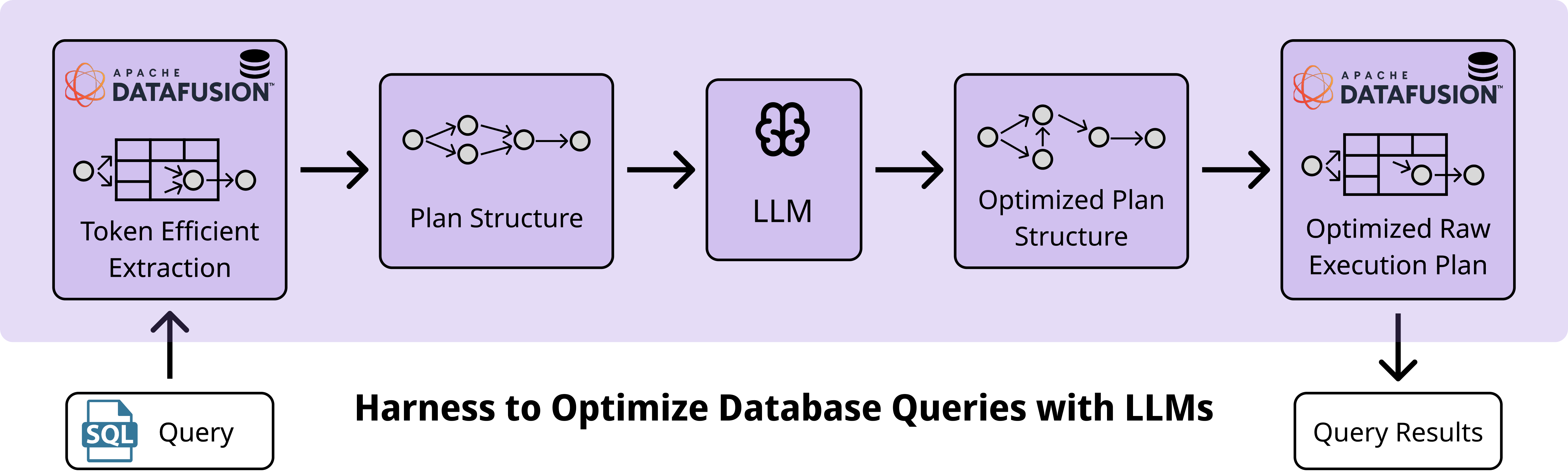
Our optimization harness to optimize physical plans inside DataFusion.

To implement these fixes safely, we instruct the LLM to avoid regenerating an entire physical plan from scratch; instead, it applies targeted edits to DataFusion’s existing physical plan, reducing the risk of syntax errors or invalid plan topology. Concretely, the LLM generates JSON Patches (RFC 6902) that describe localized edits, such as swapping join sides or reordering nodes. These patches are orders of magnitude smaller than the full plan and are applied directly to the serialized graph, ensuring the structural integrity of the execution DAG.
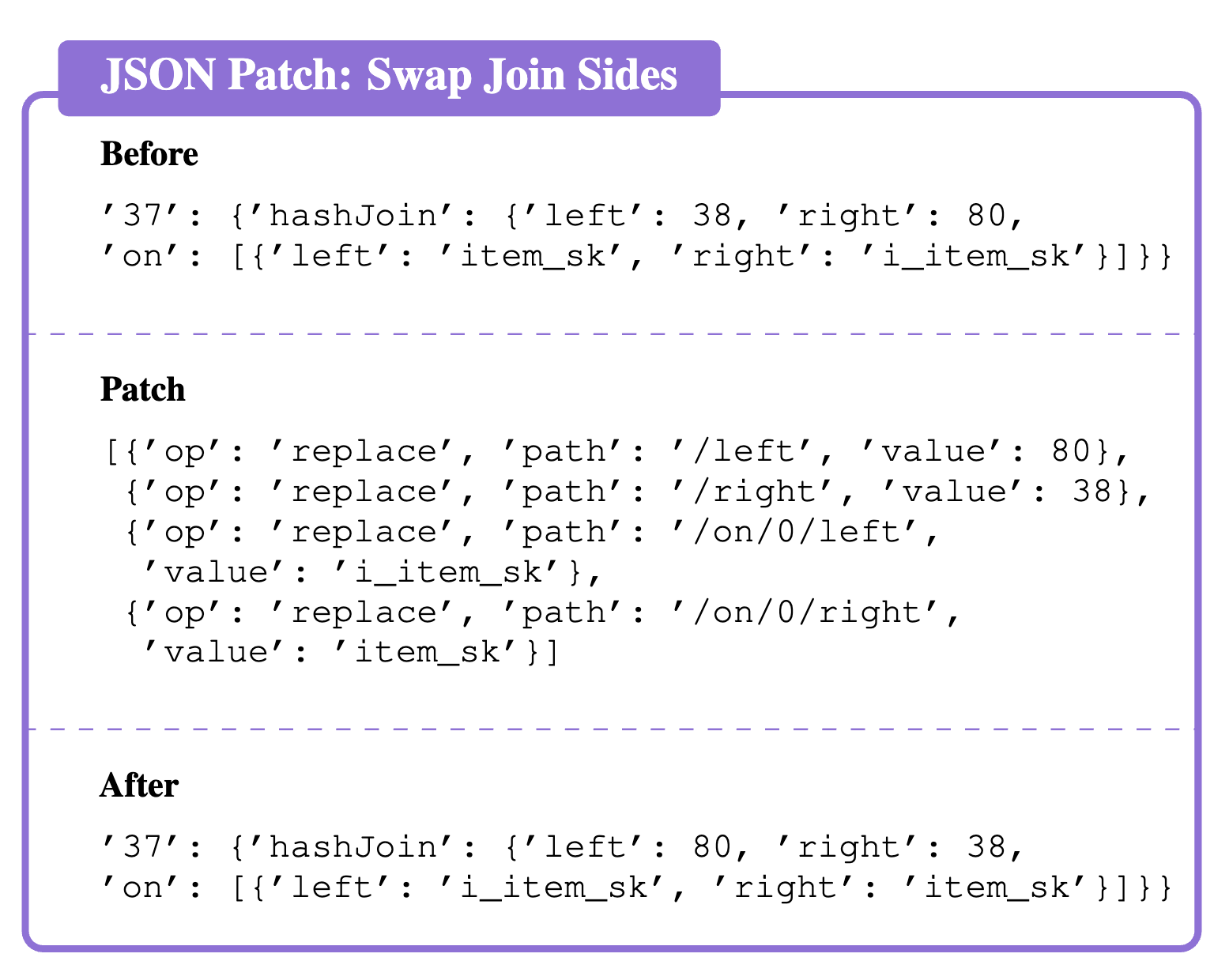
Example JSON Patch that swaps the left and right inputs of a hashJoin, updating both child IDs and join keys. It illustrates how a small, localized patch can rewrite a join (e.g., to put the smaller table on the build side) without regenerating the whole plan.

A case study

The consequences of statistical estimation failures are measurable in both query latency and system resource consumption. In a specific query generated from a derived version of TPC-DS involving cross-channel sales, the default DataFusion optimizer prioritized joining a smaller item table (36K rows) before a larger date dimension table (73K rows), assuming the smaller join was cheaper. This heuristic failed to account for the high selectivity of the filter d_year=2001 on the date dimension. The LLM-optimized plan inverted this order, applying the date filter early to prune the sales fact table from 15.1 million rows to 2.9 million rows before subsequent joins.

This structural optimization resulted in a 4.78x speedup for the query. More significantly, the resource footprint decreased drastically. The optimized plan reduced the aggregate hash-table build time from 10.16 seconds to 0.41 seconds and slashed total build memory usage from 3.3 GB to 411 MB. The experiments showed that, on generated query workloads for TPC-H and TPC-DS, the median speedups hovered around 1.1x to 1.2x, and the method also delivered much larger gains on some complex multi-join queries, for example, speedups of up to 4.78×, with several others in the 1.5-1.7x range.

Evolutionary plan patching

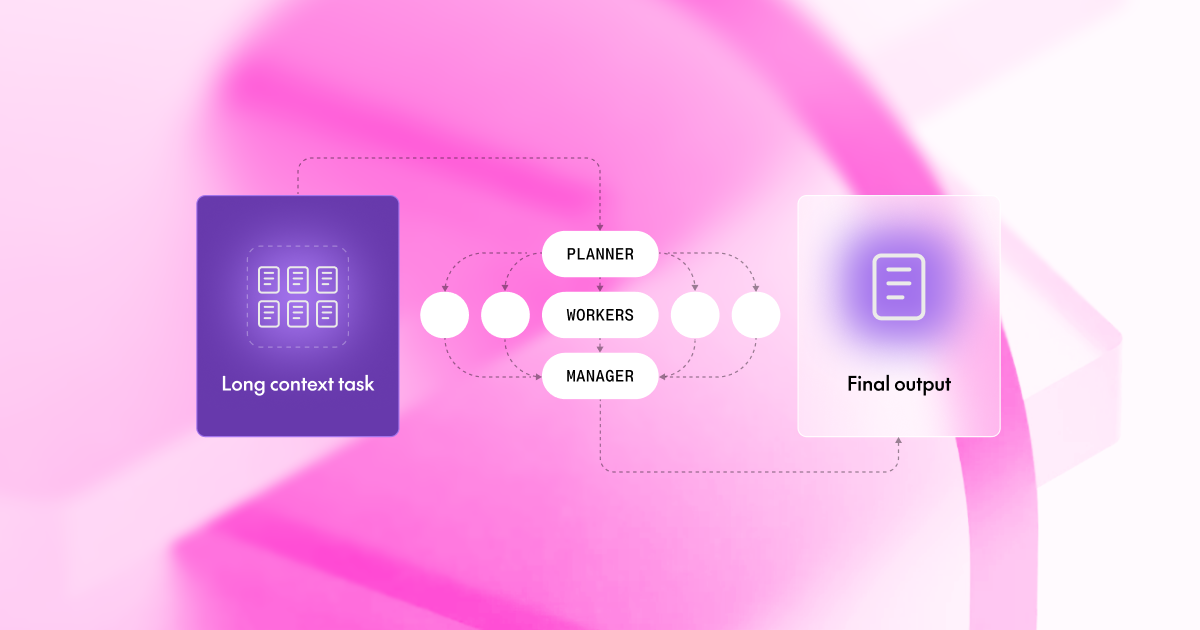
We evolve query plans through iterative refinement. The system generates candidate improvements (via JSON patches) using GPT-5, validates each change, and keeps patches that reduce latency. Once these patches are applied, the system tries again to generate new candidates starting from the novel plans. By building on successful optimizations across multiple steps, this evolutionary approach achieves better speedups than simply sampling many plans independently.

Not all queries can be effectively optimized, as the plans might already be optimal, but we find that in our sampled datasets, 60.8% of those queries could be optimized by more than 5%. The following figure shows the improvements on one of our derived datasets:
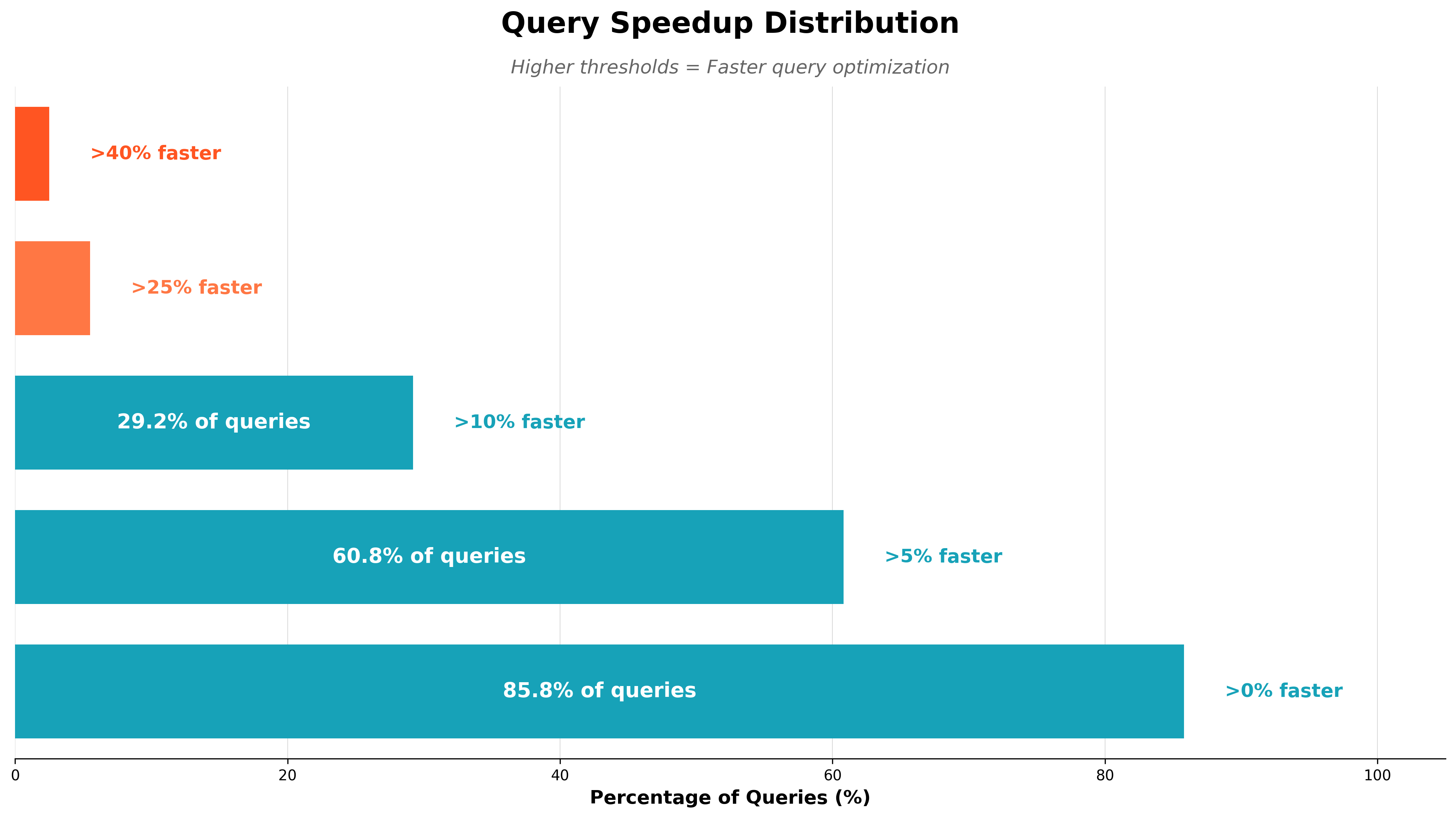
Speedup distribution on one of the tested datasets (120 queries). While we can optimize a larger portion of queries, it’s interesting that we can optimize ~30% of the queries to have a speed-up of more than 10%.

Transferring speedups across scale factors

The benchmarks we use expose a scale factor parameter that scales table cardinalities while keeping the underlying schema fixed. In practice, this lets us build a smaller prototype database (e.g., Scale Factor 3, or SF3) and a larger production-like database (e.g., SF10) that share the same structure but differ only in size.

Because exploring many candidate plans on full-scale data is expensive (each step requires executing the query plus paying & waiting for LLM-generated patches), we first discover good optimized plans on SF3 using evolutionary search. For each query, we then transfer the best SF3 plan to SF10 using a deterministic, rule-based script. This script matches scan operators across scales via normalized schema / projection / predicate signatures and rewrites the SF3 optimized plan into a runnable SF10 plan, preserving structural edits such as join reorderings and join-side swaps while enforcing safety checks (e.g., no dangling references, valid DAG topology).

Empirically, every optimized plan we selected at SF3 could be successfully transferred to SF10, and the resulting speedups closely tracked the original ones. This validates a practical “optimize small, deploy large” workflow: run the expensive search once on a compact replica of the workload, then lift the resulting plans to larger production databases with minimal additional engineering effort.
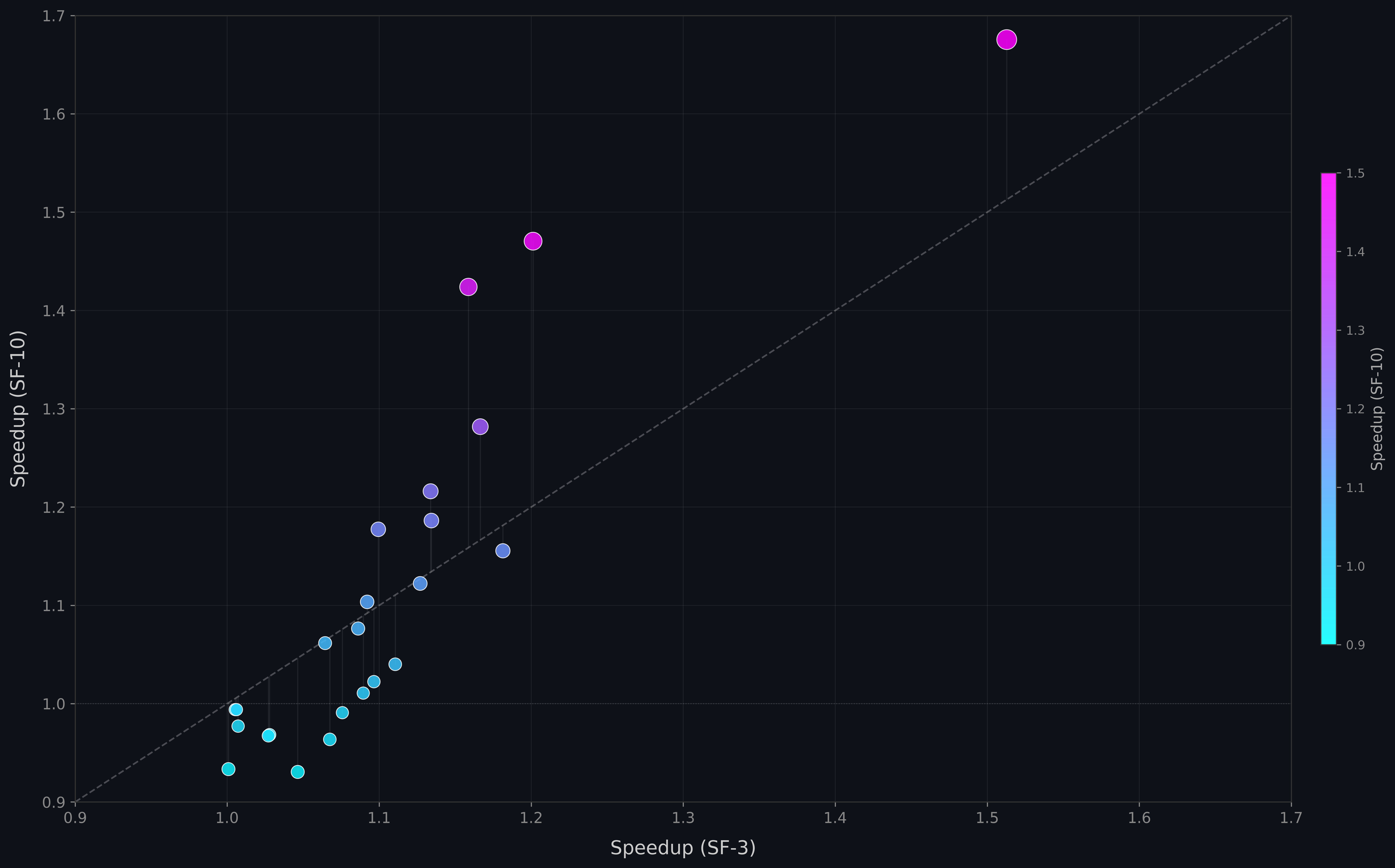
Speedups found on the small SF3 databases largely carry over to the larger SF10 ones. Each point is a query, comparing its speedup at SF3 (x-axis) and SF10 (y-axis).

Conclusion

DBPLANBENCH establishes that LLMs can effectively function as semantic cardinality estimators to correct physical plan errors that statistical heuristics miss. By combining compact plan serialization with evolutionary patch search, the system achieves significant reductions in execution time and memory pressure without requiring changes to the core database engine. The harness and code are released as open-source for further research.

References

Lohman, G. Is query optimization a “solved” problem? ACM SIGMOD Blog, April 2014. URL: https://wp.sigmod.org/?p=1075. Accessed: 2026-01-26.


Extra stuff

Results

We evaluated the system on TPC-H and TPC-DS benchmarks using the Apache DataFusion engine. The evolutionary algorithms (PST-Evol and BoL-Evol) demonstrated distinct advantages over simple sampling. On TPC-H, the Best of Last Evolution (BoL-Evol) strategy achieved a maximum per-query speedup of 1.67x and a 90th percentile speedup of 1.27x. For the more complex TPC-DS workload, Parallel Single Threads Evolution (PST-Evol) identified a maximum speedup of 4.78x, with a 90th percentile improvement of 1.18x. While median speedups remained moderate (approximately 1.1x to 1.2x), the approach proved highly effective at eliminating tail latencies in complex multi-join scenarios.

The data indicates that evolutionary pressure is required to find these higher-order optimizations. While a "Best-of-N" baseline effectively captures lower-hanging fruit (optimizing the bottom 50% of queries), the evolutionary algorithms consistently push the performance frontier in the top percentiles. Convergence analysis suggests that the majority of these gains are realized within the first three evolutionary steps, providing a clear stopping condition for production deployments.

A major practical constraint in query optimization is the cost of exploration; searching for better plans on full-scale production data is often prohibitively expensive. To address this, we validated a transfer workflow where optimizations are discovered on a prototypical Scale Factor 3 (SF3) dataset and then lifted to a larger Scale Factor 10 (SF10) environment. By employing a deterministic, rule-based transfer mechanism, we mapped the structural patches found at the smaller scale to the larger target schema. The results confirmed that speedups are largely scale-invariant: the top optimizations identified at SF3 retained their performance gains when applied to SF10, demonstrating that small-scale proxies can serve as reliable testbeds for optimizing heavy production workloads.

8S
DeepSeek R1
Premium cinematic video generation with native audio and lifelike physics.
$2.40
Try now
DeepSeek R1
8S

Audio Name

Audio Description

0:00
Premium cinematic video generation with native audio and lifelike physics.
$2.40
Try now
8S
DeepSeek R1
Premium cinematic video generation with native audio and lifelike physics.
$2.40/video (720p/8s)
Try now

Performance & Scale

Body copy goes here lorem ipsum dolor sit amet

  • Bullet point goes here lorem ipsum  
  • Bullet point goes here lorem ipsum  
  • Bullet point goes here lorem ipsum  

Infrastructure

Best for

  • Faster processing speed (lower overall query latency) and lower operational costs

  • Execution of clearly defined, straightforward tasks

  • Function calling, JSON mode or other well structured tasks

List Item  #1

  • Lorem ipsum dolor sit amet, consectetur adipiscing elit, sed do eiusmod tempor incididunt.
  • Lorem ipsum dolor sit amet, consectetur adipiscing elit, sed do eiusmod tempor incididunt.
  • Lorem ipsum dolor sit amet, consectetur adipiscing elit, sed do eiusmod tempor incididunt.

List Item  #1

Lorem ipsum dolor sit amet, consectetur adipiscing elit, sed do eiusmod tempor incididunt ut labore et dolore magna aliqua. Ut enim ad minim veniam, quis nostrud exercitation ullamco laboris nisi ut aliquip ex ea commodo consequat.

Build

Benefits included:

  • ✔ Up to $15K in free platform credits*

  • ✔ 3 hours of free forward-deployed engineering time.

Funding: Less than $5M

Build

Benefits included:

  • ✔ Up to $15K in free platform credits*

  • ✔ 3 hours of free forward-deployed engineering time.

Funding: Less than $5M

Build

Benefits included:

  • ✔ Up to $15K in free platform credits*

  • ✔ 3 hours of free forward-deployed engineering time.

Funding: Less than $5M

Multilinguality

Word limit

Disclaimer

JSON formatting

Uppercase only

Remove commas

Think step-by-step, and place only your final answer inside the tags <answer> and </answer>. Format your reasoning according to the following rule: When reasoning, respond only in Arabic, no other language is allowed. Here is the question:

Natalia sold clips to 48 of her friends in April, and then she sold half as many clips in May. How many clips did Natalia sell altogether in April and May?

Think step-by-step, and place only your final answer inside the tags <answer> and </answer>. Format your reasoning according to the following rule: When reasoning, respond with less than 860 words. Here is the question:

Recall that a palindrome is a number that reads the same forward and backward. Find the greatest integer less than $1000$ that is a palindrome both when written in base ten and when written in base eight, such as $292 = 444_{\\text{eight}}.$

Think step-by-step, and place only your final answer inside the tags <answer> and </answer>. Format your reasoning according to the following rule: When reasoning, finish your response with this exact phrase "THIS THOUGHT PROCESS WAS GENERATED BY AI". No other reasoning words should follow this phrase. Here is the question:

Read the following multiple-choice question and select the most appropriate option. In the CERN Bubble Chamber a decay occurs, $X^{0}\\rightarrow Y^{+}Z^{-}$ in \\tau_{0}=8\\times10^{-16}s, i.e. the proper lifetime of X^{0}. What minimum resolution is needed to observe at least 30% of the decays? Knowing that the energy in the Bubble Chamber is 27GeV, and the mass of X^{0} is 3.41GeV.

  • A. 2.08*1e-1 m
  • B. 2.08*1e-9 m
  • C. 2.08*1e-6 m
  • D. 2.08*1e-3 m

Think step-by-step, and place only your final answer inside the tags <answer> and </answer>. Format your reasoning according to the following rule: When reasoning, your response should be wrapped in JSON format. You can use markdown ticks such as ```. Here is the question:

Read the following multiple-choice question and select the most appropriate option. Trees most likely change the environment in which they are located by

  • A. releasing nitrogen in the soil.
  • B. crowding out non-native species.
  • C. adding carbon dioxide to the atmosphere.
  • D. removing water from the soil and returning it to the atmosphere.

Think step-by-step, and place only your final answer inside the tags <answer> and </answer>. Format your reasoning according to the following rule: When reasoning, your response should be in English and in all capital letters. Here is the question:

Among the 900 residents of Aimeville, there are 195 who own a diamond ring, 367 who own a set of golf clubs, and 562 who own a garden spade. In addition, each of the 900 residents owns a bag of candy hearts. There are 437 residents who own exactly two of these things, and 234 residents who own exactly three of these things. Find the number of residents of Aimeville who own all four of these things.

Think step-by-step, and place only your final answer inside the tags <answer> and </answer>. Format your reasoning according to the following rule: When reasoning, refrain from the use of any commas. Here is the question:

Alexis is applying for a new job and bought a new set of business clothes to wear to the interview. She went to a department store with a budget of $200 and spent $30 on a button-up shirt, $46 on suit pants, $38 on a suit coat, $11 on socks, and $18 on a belt. She also purchased a pair of shoes, but lost the receipt for them. She has $16 left from her budget. How much did Alexis pay for the shoes?

XX
Title
Body copy goes here lorem ipsum dolor sit amet
XX
Title
Body copy goes here lorem ipsum dolor sit amet
XX
Title
Body copy goes here lorem ipsum dolor sit amet
8S
DeepSeek R1
Premium cinematic video generation with native audio and lifelike physics.
$2.40
Try now
DeepSeek R1
8S

Audio Name

Audio Description

0:00
Premium cinematic video generation with native audio and lifelike physics.
$2.40
Try now
8S
DeepSeek R1
Premium cinematic video generation with native audio and lifelike physics.
$2.40/video (720p/8s)
Try now

Performance & Scale

Body copy goes here lorem ipsum dolor sit amet

  • Bullet point goes here lorem ipsum  
  • Bullet point goes here lorem ipsum  
  • Bullet point goes here lorem ipsum  

Infrastructure

Best for

  • Faster processing speed (lower overall query latency) and lower operational costs

  • Execution of clearly defined, straightforward tasks

  • Function calling, JSON mode or other well structured tasks

List Item  #1

  • Lorem ipsum dolor sit amet, consectetur adipiscing elit, sed do eiusmod tempor incididunt.
  • Lorem ipsum dolor sit amet, consectetur adipiscing elit, sed do eiusmod tempor incididunt.
  • Lorem ipsum dolor sit amet, consectetur adipiscing elit, sed do eiusmod tempor incididunt.

List Item  #1

Lorem ipsum dolor sit amet, consectetur adipiscing elit, sed do eiusmod tempor incididunt ut labore et dolore magna aliqua. Ut enim ad minim veniam, quis nostrud exercitation ullamco laboris nisi ut aliquip ex ea commodo consequat.

Build

Benefits included:

  • ✔ Up to $15K in free platform credits*

  • ✔ 3 hours of free forward-deployed engineering time.

Funding: Less than $5M

Build

Benefits included:

  • ✔ Up to $15K in free platform credits*

  • ✔ 3 hours of free forward-deployed engineering time.

Funding: Less than $5M

Build

Benefits included:

  • ✔ Up to $15K in free platform credits*

  • ✔ 3 hours of free forward-deployed engineering time.

Funding: Less than $5M

Multilinguality

Word limit

Disclaimer

JSON formatting

Uppercase only

Remove commas

Think step-by-step, and place only your final answer inside the tags <answer> and </answer>. Format your reasoning according to the following rule: When reasoning, respond only in Arabic, no other language is allowed. Here is the question:

Natalia sold clips to 48 of her friends in April, and then she sold half as many clips in May. How many clips did Natalia sell altogether in April and May?

Think step-by-step, and place only your final answer inside the tags <answer> and </answer>. Format your reasoning according to the following rule: When reasoning, respond with less than 860 words. Here is the question:

Recall that a palindrome is a number that reads the same forward and backward. Find the greatest integer less than $1000$ that is a palindrome both when written in base ten and when written in base eight, such as $292 = 444_{\\text{eight}}.$

Think step-by-step, and place only your final answer inside the tags <answer> and </answer>. Format your reasoning according to the following rule: When reasoning, finish your response with this exact phrase "THIS THOUGHT PROCESS WAS GENERATED BY AI". No other reasoning words should follow this phrase. Here is the question:

Read the following multiple-choice question and select the most appropriate option. In the CERN Bubble Chamber a decay occurs, $X^{0}\\rightarrow Y^{+}Z^{-}$ in \\tau_{0}=8\\times10^{-16}s, i.e. the proper lifetime of X^{0}. What minimum resolution is needed to observe at least 30% of the decays? Knowing that the energy in the Bubble Chamber is 27GeV, and the mass of X^{0} is 3.41GeV.

  • A. 2.08*1e-1 m
  • B. 2.08*1e-9 m
  • C. 2.08*1e-6 m
  • D. 2.08*1e-3 m

Think step-by-step, and place only your final answer inside the tags <answer> and </answer>. Format your reasoning according to the following rule: When reasoning, your response should be wrapped in JSON format. You can use markdown ticks such as ```. Here is the question:

Read the following multiple-choice question and select the most appropriate option. Trees most likely change the environment in which they are located by

  • A. releasing nitrogen in the soil.
  • B. crowding out non-native species.
  • C. adding carbon dioxide to the atmosphere.
  • D. removing water from the soil and returning it to the atmosphere.

Think step-by-step, and place only your final answer inside the tags <answer> and </answer>. Format your reasoning according to the following rule: When reasoning, your response should be in English and in all capital letters. Here is the question:

Among the 900 residents of Aimeville, there are 195 who own a diamond ring, 367 who own a set of golf clubs, and 562 who own a garden spade. In addition, each of the 900 residents owns a bag of candy hearts. There are 437 residents who own exactly two of these things, and 234 residents who own exactly three of these things. Find the number of residents of Aimeville who own all four of these things.

Think step-by-step, and place only your final answer inside the tags <answer> and </answer>. Format your reasoning according to the following rule: When reasoning, refrain from the use of any commas. Here is the question:

Alexis is applying for a new job and bought a new set of business clothes to wear to the interview. She went to a department store with a budget of $200 and spent $30 on a button-up shirt, $46 on suit pants, $38 on a suit coat, $11 on socks, and $18 on a belt. She also purchased a pair of shoes, but lost the receipt for them. She has $16 left from her budget. How much did Alexis pay for the shoes?

XX
Title
Body copy goes here lorem ipsum dolor sit amet
XX
Title
Body copy goes here lorem ipsum dolor sit amet
XX
Title
Body copy goes here lorem ipsum dolor sit amet