Key Takeaways
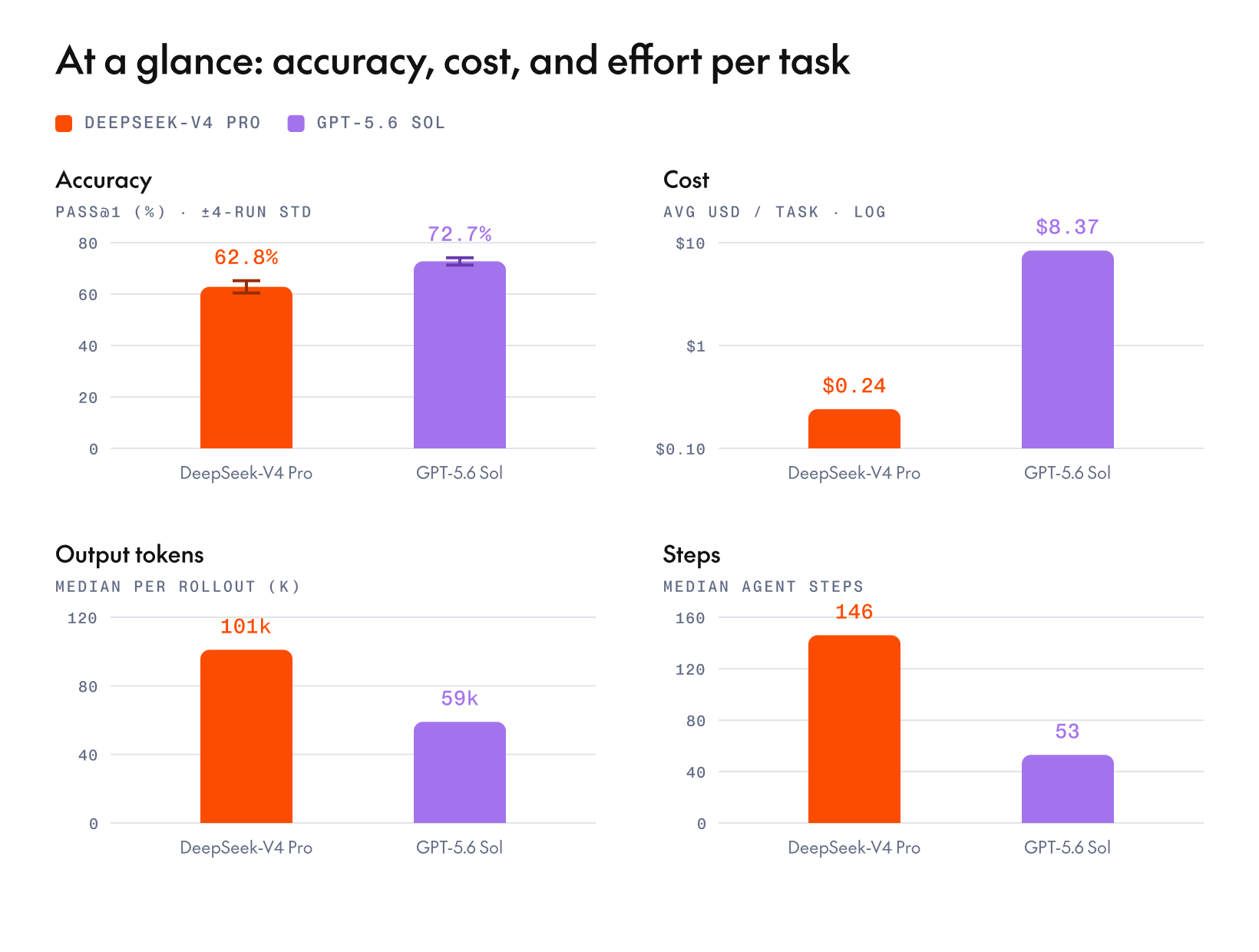
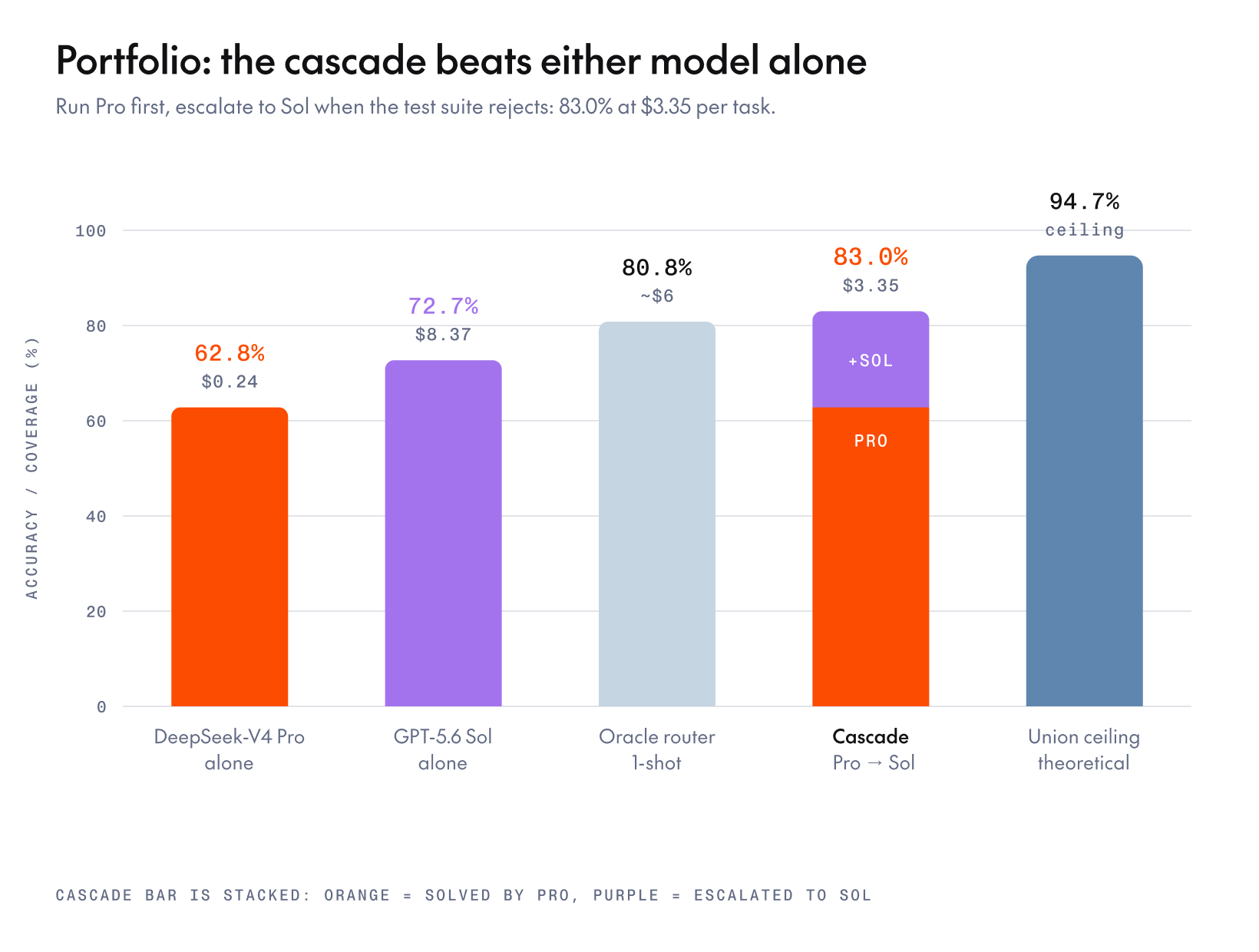
Don't pick one. Run DeepSeek V4 Pro 0813 first, escalate to GPT-5.6 Sol when the tests fail. That cascade solves 83.0% of DeepSWE tasks at \$3.35 each. Sol alone solves 72.7% at \$8.37. Ten points better, 60% cheaper.
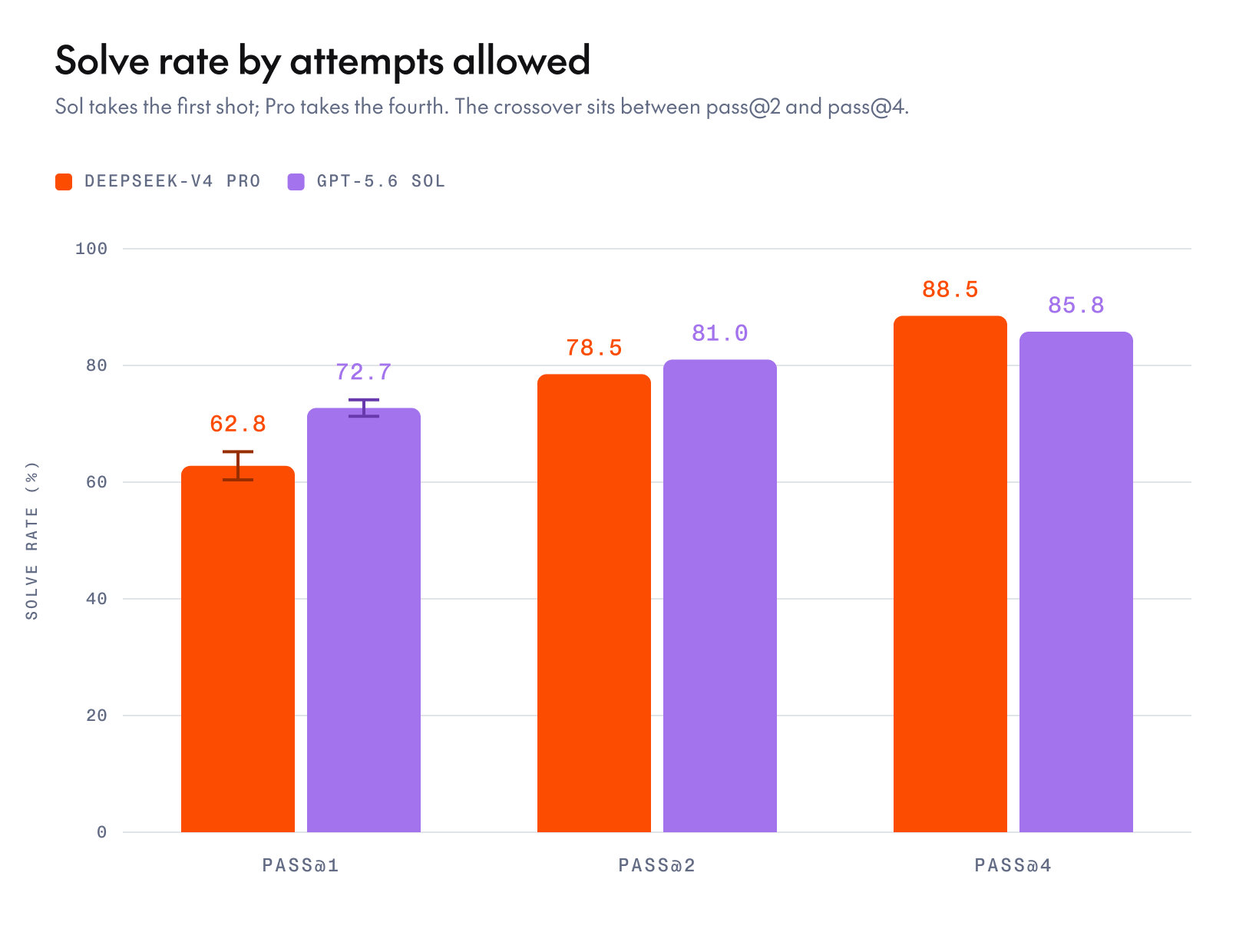
- Sol wins the early attempts. 72.7% pass@1 vs 62.8%, and it holds the lead at pass@2 (81.0% vs 78.5%).
- Pro wins the last one. 88.5% pass@4 vs 85.8%. Given four tries, the cheap model finds more of the board.
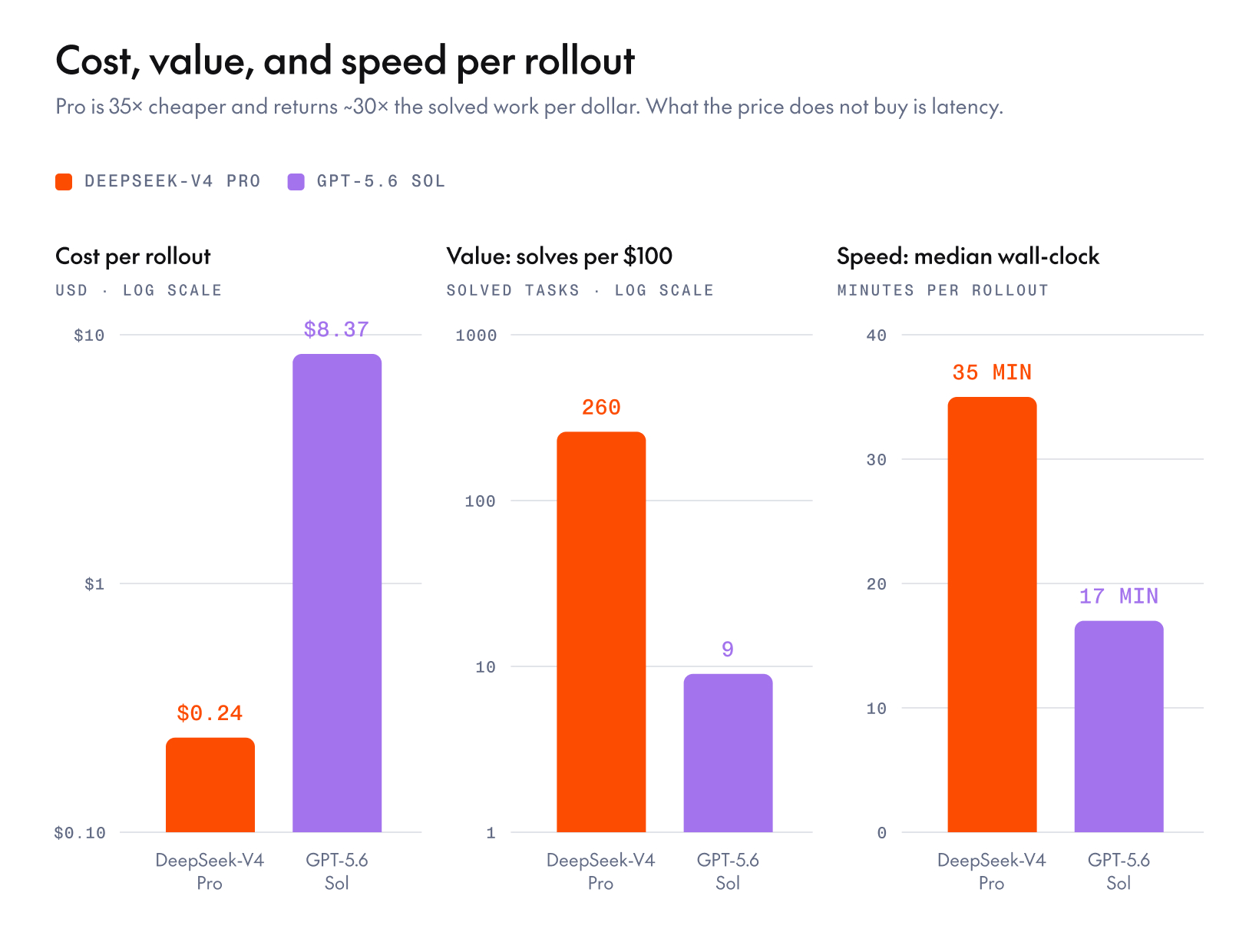
- The price gap is 35x. \$0.24 per rollout vs \$8.37. Per \$100 spent, Pro solves 261 tasks and Sol solves 9.
- Sol is faster and steadier. 17 minutes and 53 steps per rollout vs Pro's 35 and 146, and 61 tasks solved four-for-four vs 35.
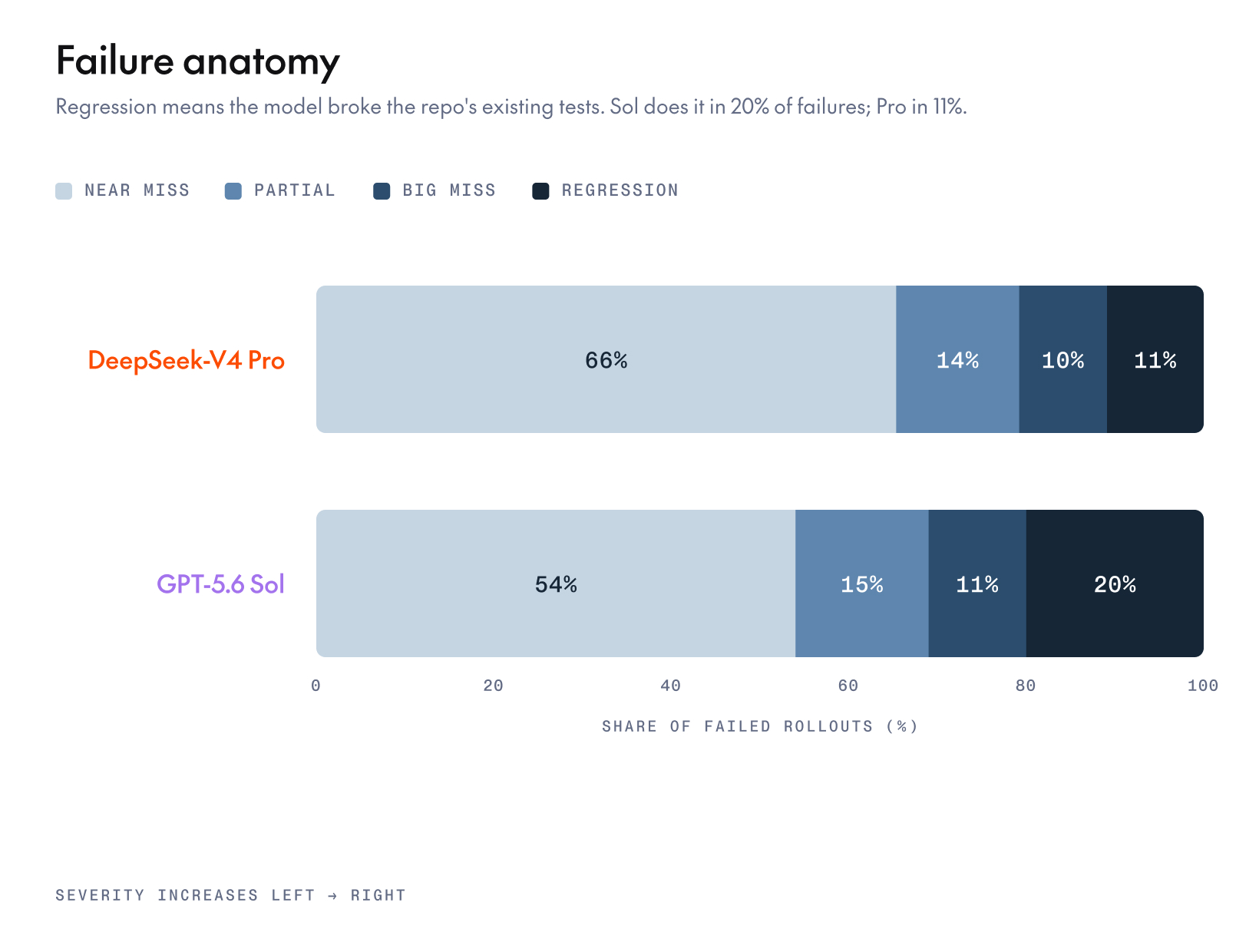
- Sol's failures are messier. 20% of them break tests that already passed, vs 11% for Pro. Gate Sol's output on regressions.
In our DeepSeek V4 Pro 0813 vs GPT-5.6 Sol comparison on DeepSWE, a benchmark that tests a model's software engineering ability across many task types and programming languages, GPT-5.6 Sol is the best single-shot engineer on the board, and DeepSeek V4 Pro 0813 costs one-thirty-fifth as much. The interesting question is not which is more accurate on the first try (Sol, clearly) but what that 35x price gap actually buys, and whether the lower-cost model's ceiling closes it.
We ran DeepSeek V4 Pro 0813 (max) against GPT-5.6 Sol (max) on all 113 DeepSWE tasks, four trials each, from the published per-trial records: 904 rollouts in total (452 each). Sol is the precision flagship; Pro is the value outlier. Every figure below comes from this run, so it can differ from other public DeepSeek V4 Pro 0813 vs GPT-5.6 Sol scorecards.
The DeepSWE scoreboard: pass@1 and pass@k
Single shot, Sol leads clearly: 72.7% pass@1 to Pro's 62.8% (official scoring). But the gap narrows with every retry and then inverts: at two attempts Pro is already close (78.5 vs 81.0), and at four Pro's 88.5% pass@4 passes Sol's 85.8%. The lower-cost model has the wider reach; it needs more than one attempt, and its attempts are nearly free. If your workload lets you run best-of-k, the accuracy argument for Sol largely disappears.
Cost comparison: DeepSeek V4 Pro 0813 vs GPT-5.6 Sol pricing
At \$0.24 a rollout, DeepSeek V4 Pro 0813 is 35x cheaper than Sol (\$8.37), which in value terms is 260 solves per \$100 against Sol's 9. What the lower price does not buy is speed or brevity: Pro takes a median 146 steps and 35 minutes and emits 101k output tokens, versus Sol's tight 53 steps, 17 minutes, and 59k tokens. Sol is the fast, concise specialist; Pro reaches similar coverage the long way around. If a human is waiting, Sol earns its premium on latency alone; if a budget or a queue is waiting, nothing here is close to Pro.
Coverage vs reliability: precision vs reach
Decompose pass@1 into coverage and reliability and the split is clean. Sol is the precision corner: 84.5% reliability and 61 tasks solved four-for-four, the marks of a model that nails what it touches. DeepSeek V4 Pro 0813 trades to the other axis: wider coverage (88.5% vs 85.8%) but far lower reliability (71.0%) and fewer solid tasks (35 vs 61). That is the pass@4 crossover seen from the side: Pro touches more of the benchmark than Sol but converts each touch less often per shot.
Failure modes: how each model gets it wrong
The failure profiles differ sharply. Sol breaks the repository's existing test suite in 20% of its failures, the GPT-family regression signature. DeepSeek V4 Pro 0813 is far more conservative at 11%; when it fails, it usually fails with a near miss and the baseline intact. So the cheaper model is also the safer one to accept unreviewed: put a full regression gate around Sol before you take its diff, and Pro needs that guardrail less.
Where each wins, by task type
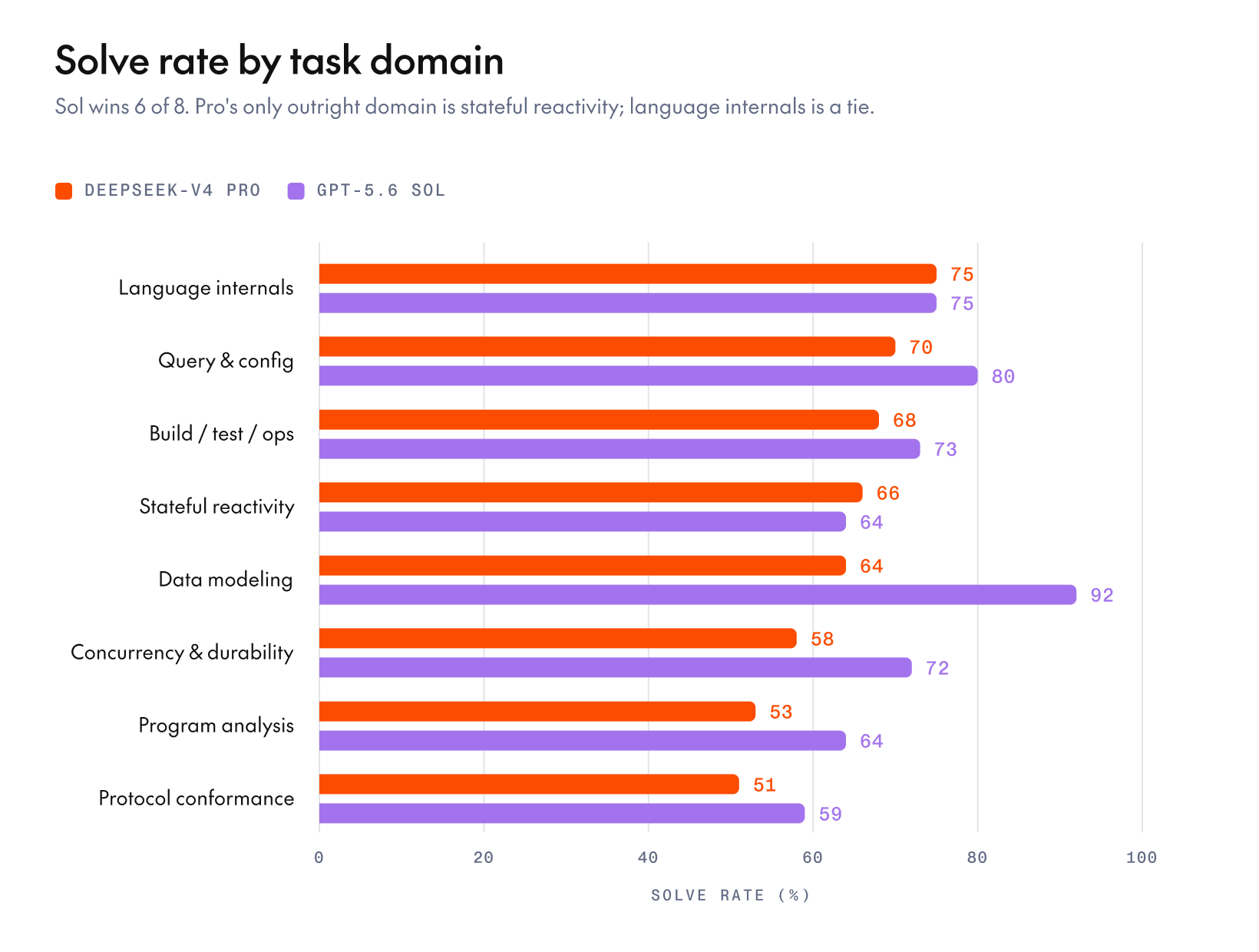
Sol's quality edge is broad: it wins 6 of 8 domains, led by data modeling and serialization at 92% (28 points over Pro), plus query/config (80), concurrency (72), build/ops (73), program analysis (64), and protocol conformance (59). The two it does not take are narrow: language and runtime internals is a 75-75 tie, and DeepSeek V4 Pro 0813 edges stateful reactivity (66 vs 64), its one domain win. Everywhere the task demands nailing an exact serialization contract, Sol pulls away.
DeepSeek V4 Pro 0813 vs GPT-5.6 Sol by programming language
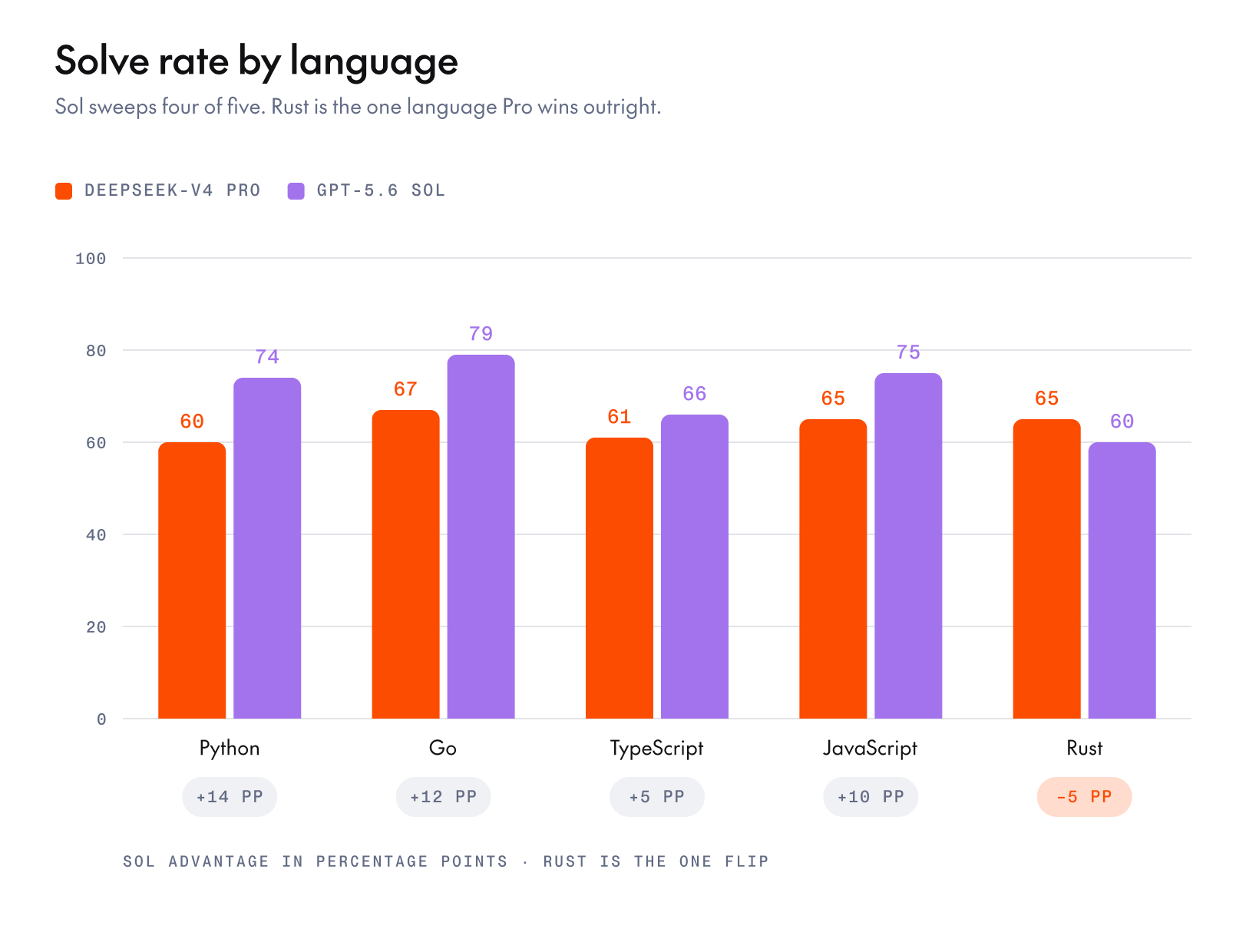
Sol sweeps four of five (Python 74, Go 79, TypeScript 66, JavaScript 75), and the margins are wide on Python and Go. The exception is Rust, where DeepSeek V4 Pro 0813 edges ahead 65 to 60: the one language Sol underperforms its class and the one Pro wins outright. If your stack is Python or Go, this is Sol's board by a comfortable margin; if it is Rust, Pro is fractionally better and vastly cheaper.
How different are DeepSeek V4 Pro 0813 and GPT-5.6 Sol?
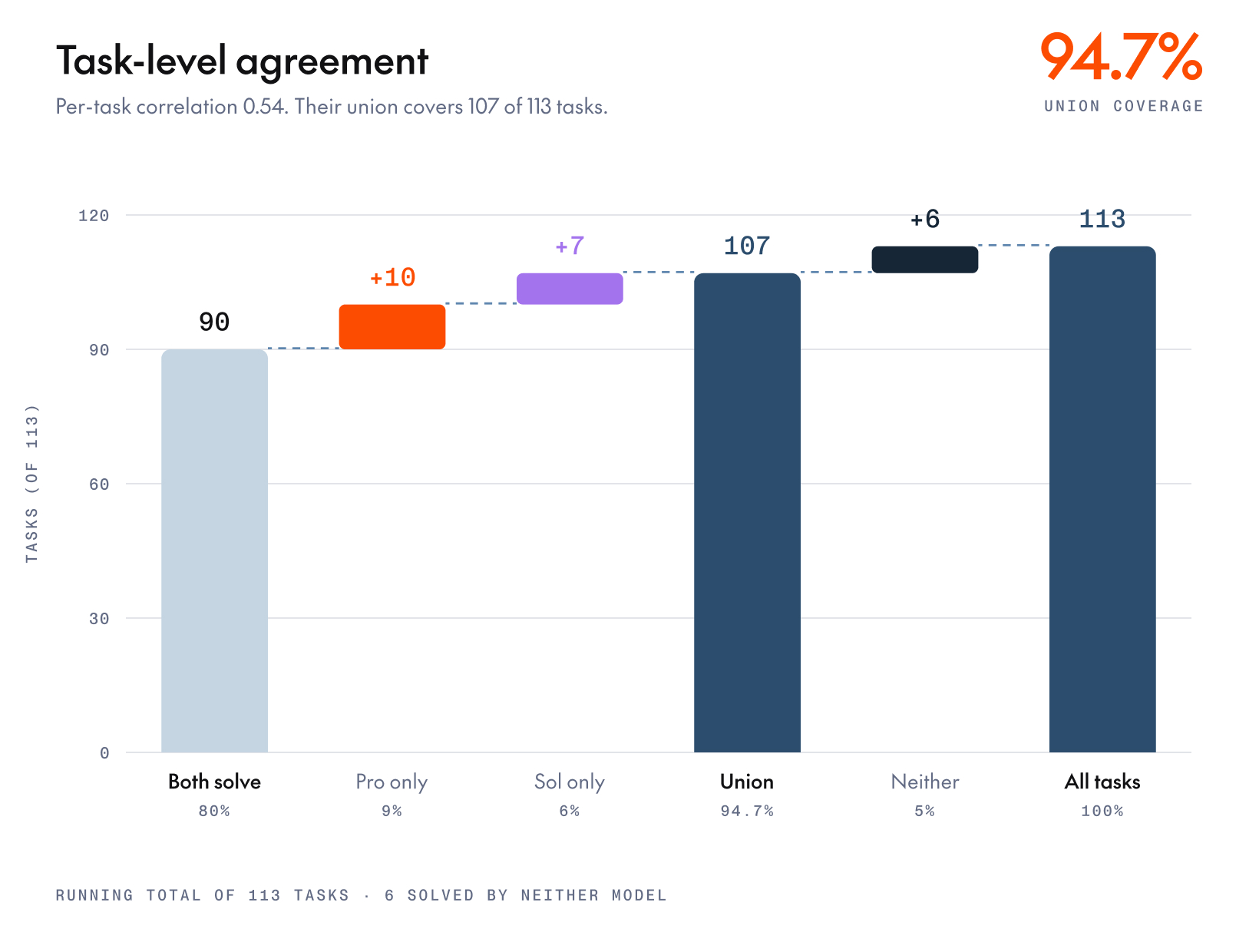
Moderately. Per-task correlation is 0.54, the closest of the DeepSeek-Pro pairings. They both solve 90 tasks; Pro alone gets 10, Sol alone gets 7, and 6 defeat both. Their union covers 107 of 113 (94.7%). One asymmetry matters for a portfolio: DeepSeek V4 Pro 0813 sweeps no task that Sol misses entirely, while Sol goes four-for-four on two tasks that Pro never solves (pebble-durability-wait-apis, textual-kitty-key-phases). So Pro does not add much new reach on top of Sol; what it adds is the ability to clear the shared tasks at minimal cost.
Routing between them: the portfolio play
Which is exactly why the cascade wins. Run DeepSeek V4 Pro 0813 first and escalate to Sol only when your test suite rejects the answer: 83.0% solved at \$3.35 per task. That is ten points above Sol alone (72.7%) for less than half of Sol's own per-task price (\$8.37). The near-free first stage clears most of the queue, so Sol's premium price applies only to the hard remainder, and the tasks that reach Sol get a second independent attempt on top. The cascade even beats a perfect one-shot oracle router (80.8%), because two independent attempts beat one perfect pick. Accuracy is the same whichever model leads, but Pro-first is far cheaper (\$3.35 vs \$8.44), so always lead with the lower-cost model.
What it means
GPT-5.6 Sol is the single-model pick when correctness and latency both matter on the first try: highest pass@1, highest reliability, fastest and most concise, and six of eight domains. You pay 35x DeepSeek V4 Pro 0813 for that, and you must guardrail its 20% regression rate. DeepSeek V4 Pro 0813 is the value and best-of-k pick: near-flagship coverage, the higher four-shot ceiling, a cleaner failure profile, at \$0.24 a rollout. But the sharpest use of the pair is neither alone, it is Pro as Sol's front-end. A low-cost first stage that clears most of the work turns Sol into a cost you only pay on the tasks that need it, and buys flagship-beating coverage for under half of Sol's price.
Data table: DeepSeek V4 Pro 0813 vs GPT-5.6 Sol, full results
FAQs
Is DeepSeek V4 Pro 0813 better than GPT-5.6 Sol?
It depends on the metric. GPT-5.6 Sol wins single-attempt quality on DeepSWE (pass@1 72.7% vs 62.8%), solves more tasks four-for-four (61 vs 35), and is much faster per rollout. DeepSeek V4 Pro 0813 wins pass@4 (88.5% vs 85.8%) at 35x lower cost per rollout, so it is the stronger value pick for high-volume or retry-tolerant agent work.
How much cheaper is DeepSeek V4 Pro 0813 than GPT-5.6 Sol?
In our run, DeepSeek V4 Pro 0813 cost \$0.24 per rollout versus \$8.37 for GPT-5.6 Sol at max effort, roughly 35x cheaper. Measured per solved task, Pro returned 260 solves per \$100 against Sol's 9, about 30x the solved work per dollar.
Which is better for coding, DeepSeek V4 Pro 0813 or GPT-5.6 Sol?
GPT-5.6 Sol leads Python (74), Go (79), TypeScript (66), and JavaScript (75), and wins 6 of 8 task domains, led by data modeling and serialization at 92%. DeepSeek V4 Pro 0813 takes Rust (65 vs 60) and edges stateful reactivity (66 vs 64). Sol is also the faster model per rollout; Pro reaches wider coverage across multiple attempts.
Should I route between DeepSeek V4 Pro 0813 and GPT-5.6 Sol?
Yes, if you can verify results. Running DeepSeek V4 Pro 0813 first and escalating to GPT-5.6 Sol when your test suite rejects the output reaches 83.0% at \$3.35 per task, beating Sol alone (72.7% at \$8.37) and a perfect one-shot oracle router (80.8%). Together the two cover 107 of 113 tasks.
What is pass@k on DeepSWE?
pass@k measures whether at least one of k attempts at a task passes the hidden test suite. pass@1 rewards getting it right first try; higher k rewards a model that can eventually reach a solution across several tries. DeepSeek V4 Pro 0813's edge grows as k increases.

.png)
.png)


.png)


.png)
.png)


.jpeg)







.png)